





Drainage Mat for Seedling Trays: Water Management, Capillary Irrigation and Root Health
2026-10-22 16:10:38
Water management at the tray chassis is one of the least discussed and most consequential decisions in a nursery. A drainage mat sitting beneath seedling trays changes how water behaves in the entire propagation bench: free water leaves the tray instead of pooling under it, moisture is supplied from below through capillary action, and root systems grow toward a stable moisture reservoir rather than chasing a wetting front.

The problem it solves is familiar to every plug grower. Overhead watering wets foliage, spreads disease, and produces wildly uneven moisture between edge and centre cells. Bottom watering without a mat floods the bench and leaves trays sitting in their own drainage. Both approaches cost labour and both produce variability that shows up as uneven germination and uneven transplant size.
This guide explains how drainage mats and capillary mat systems work with seedling trays, which tray formats pair best with them, what they do for root development and disease pressure, and how to specify the mat and tray as one system when buying from a seedling tray manufacturer.
What a Drainage Mat Actually Does
A drainage mat sits between the seedling tray and the bench. It performs two functions at once. First, it physically separates the tray base from standing water, so drain holes stay open and roots are never submerged. Second, a capillary mat variant holds and wicks moisture, drawing water across the mat surface so seedling roots reaching the drain hole find a consistent water supply.
Because water is delivered from below, the medium surface stays drier than it would under overhead irrigation. That single change reduces the humidity conditions that favour damping-off and foliar disease, while keeping the root zone evenly moist.
Removes standing water: keeps drain holes functioning and root zones oxygenated.
Capillary supply: wicks moisture to every cell, reducing edge-to-centre variability.
Lower disease pressure: foliage stays dry, cutting damping-off and botrytis risk.
Labour reduction: moisture reservoir buffers the bench between irrigation events.
Cleaner benches: less algae and less runoff to manage in the greenhouse.
Capillary Mat Irrigation: How Uniformity Is Achieved
Capillary action moves water through the mat against gravity, driven by surface tension in the mat's pore structure. Water is fed to one end of a slightly sloped bench or trough, and capillary tension distributes it across the full mat surface. Seedling roots growing through the tray's drain holes reach that reservoir directly.
Uniformity depends on three things: mat material with consistent pore structure, a level or correctly graded bench, and trays whose drain holes actually contact the mat. Warped trays that lift off the mat break capillary contact and dry out — another reason tray dimensional stability matters in a mat-based system.
Pairing Mats With Tray Cell Counts
| Tray format | Mat pairing | Why |
|---|---|---|
| 72-cell / 105-cell / 128-cell | Standard capillary mat | Uniform cell density gives uniform wicking |
| 100-cell / 136-cell | Capillary mat with higher reservoir capacity | Higher plant density draws more water per square metre |
| Deep cells and root control containers | Drainage mat with free-drain base | Deep root systems need oxygen as well as moisture |
| Shallow trays (no holes) | Drainage mat only | No drain holes means no capillary uptake |
| Floating trays (rice, hydroponics) | Not applicable | Water bed supplies moisture directly |
Root Development and Transplant Quality
Root systems respond to where water is. With a consistent moisture reservoir below the tray, roots grow downward and outward in a dense, fibrous mass rather than circling in search of moisture. That structure is what holds a plug together at transplanting and reduces transplant shock in the field.
Growers adopting mat systems typically report the practical benefit first: plugs pull cleanly from cells, and trays are easier to handle because the medium is not saturated and heavy.
Maintenance and Service Life
Mats need the same discipline as trays. Between cycles they should be flushed, sanitized and dried; algae and salt build-up reduce wicking performance over time. Mats should be inspected for compaction, since compressed areas lose capillary capacity and produce dry patches on the bench.
Flush and sanitize mats between production cycles.
Avoid prolonged dry-down with fertilizer salts in the mat — salt accumulation blocks pores.
Inspect for compaction and replace sections that no longer wick evenly.
Store mats flat and dry to preserve pore structure.
Frequently Asked Questions
Conclusion
Water management at the tray chassis is a lever most nurseries have not fully pulled. A correctly specified drainage mat improves uniformity, reduces disease pressure and produces the dense, fibrous root systems that transplant cleanly.
For nurseries building or upgrading a propagation bench, Ningjin County Haode New Material Co., Ltd. supplies seedling trays, drainage mats and seeding equipment from one factory in Hebei, China, with matched specifications across trays, mats and seeding equipment.
References
GB/T 7714: Capillary Mat Irrigation and Water Use Efficiency in Plug Seedling Production. Transactions of the Chinese Society of Agricultural Engineering
MLA: Comparative Analysis of Overhead, Drip and Capillary Irrigation for Seedling Trays. Horticultural Science & Technology
APA: Root Architecture Response to Sub-Irrigation in High-Density Plug Trays. Journal of Horticultural Research

The CNC Seed Braiding Machine is a high-precision, fully automated agricultural equipment s...
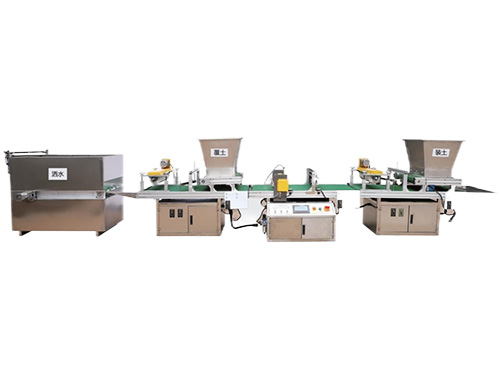
It adopts electrical integration and can be started by pressing the fully automatic button ...
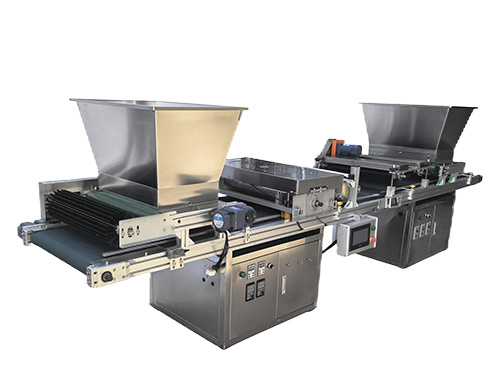
The XP750 seeder has stable performance, excellent product quality, simple and convenient o...
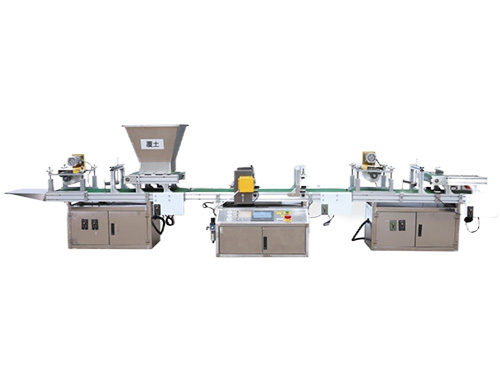
It adopts electrical integration and can be started by pressing the fully automatic button ...